How Do You Layer Sheer and Blackout Drapes on a Motorized Track System?
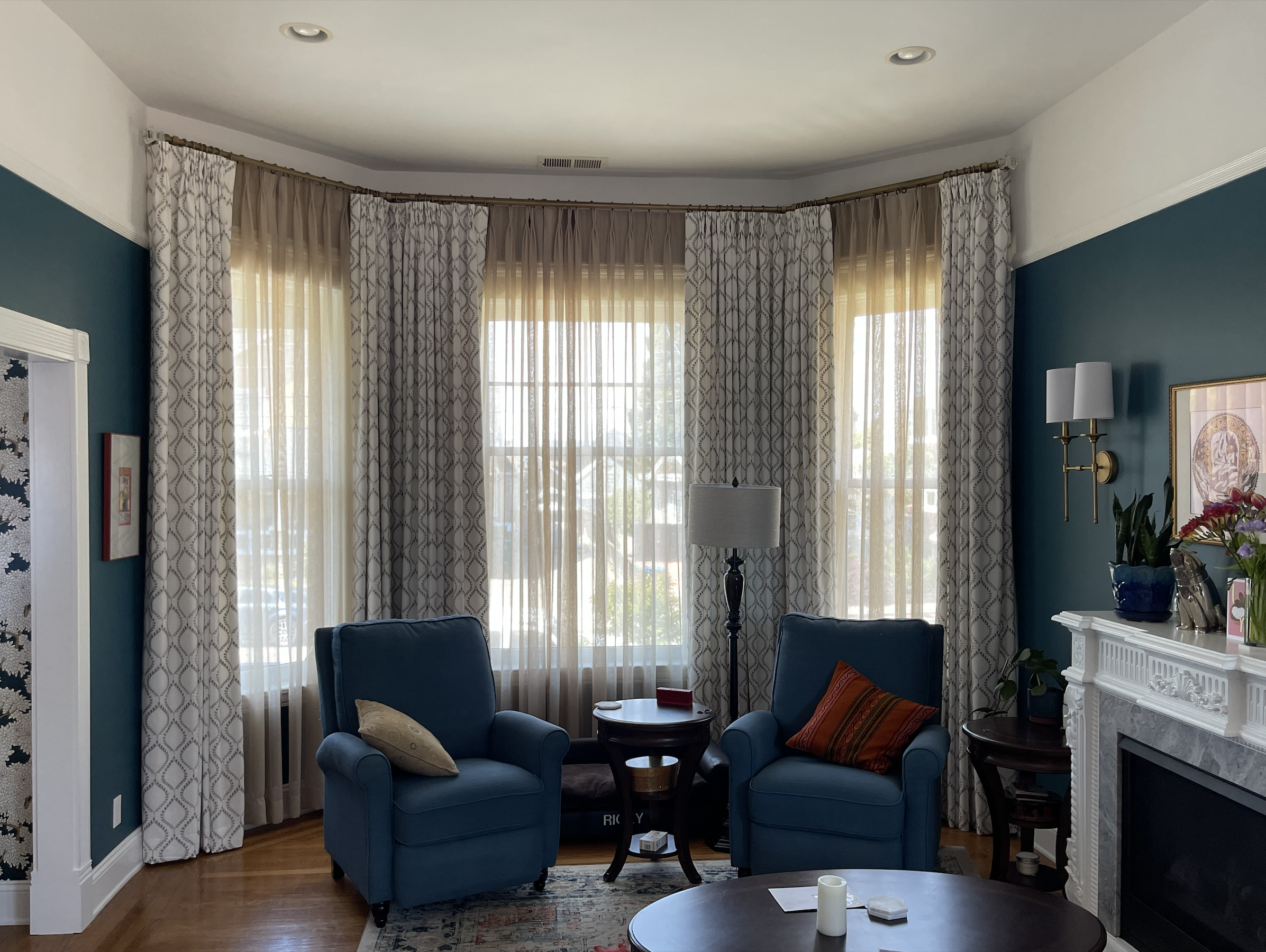
Layering sheer and blackout drapes on a motorized track requires two separate tracks mounted at different projections from the wall. The front track typically holds the sheer panel for filtered light, and the rear track holds the blackout panel for full privacy. Your fabric choice and fold style directly affect how far each track needs to sit from the wall and from each other.
A homeowner recently called us after working with a motorized track vendor who told them the track lengths and wall projections could not be finalized until the fabric and fold style were chosen. That is completely true, and it is a detail a lot of people do not expect. The two decisions are connected in ways that are easy to overlook.
At The Yardstick Inc., we handle this kind of coordination regularly. Here is what you need to understand before your tracks get ordered or installed.
Why Does Fabric Choice Affect Track Projection?
Different fabrics have different stack depths, meaning the amount of space the gathered fabric takes up when the drape is open. A heavier blackout fabric stacks thicker than a lightweight sheer. If you do not account for that, the open panels can crowd each other or block part of your window.
When you are running two tracks, the rear blackout track needs enough clearance from the wall so the front sheer track can sit in front of it without the panels touching or overlapping awkwardly. Your track installer needs those stack measurements before they can spec the bracket projection.
Does the Fold Style Change the Track Length and Projection?
Yes, fold style is one of the biggest variables in a motorized drape system. The two most common options for motorized tracks are ripple fold and pinch pleat, and they behave very differently.
- Ripple fold uses evenly spaced carriers that create a consistent wave. It works beautifully with sheer fabrics and gives a clean, modern look. The fabric fullness ratio is usually set, so the yardage and stack width are predictable.
- Pinch pleat creates more traditional, structured pleats. It tends to stack a bit bulkier, which means you may need slightly more projection between your two tracks to avoid interference.
Getting the fold style confirmed before your track vendor finalizes the hardware is not optional. It is the step that keeps the whole system working correctly.
What Is the Right Order of Operations for a Double-Layer Drape Project?
The fabric and fold style should be selected before the tracks are ordered, not after. We know that can feel like it slows things down, but it prevents expensive adjustments later.
Here is the sequence we recommend:
- Choose your fabrics for both the sheer and blackout layers.
- Decide on your fold style for each panel.
- Share those specs with your track vendor so they can calculate the correct projection brackets and track lengths.
- Have your window covering specialist measure the windows and confirm the final fabric yardage.
- Coordinate installation so the tracks go up before the panels are hung.
Our team has worked alongside motorized track vendors many times. We understand how to give them the information they need. Learn more about our custom curtains and drapes to see the fabric and style options we carry.
Do You Need a Specialist to Handle Both the Fabric and the Coordination?
Working with someone who understands both the fabric side and the hardware side saves a significant amount of back-and-forth. A lot of homeowners find themselves stuck in the middle between their track vendor and their drapery maker, translating specs neither party fully understands.
We bridge that gap. Our team, with years of experience fitting custom window treatments throughout the South Bay, can review what your track vendor needs and provide accurate stack depth and fullness specs. You can read more about our background on our about page.
Can I use any sheer fabric on a motorized ripple fold track?
Most lightweight sheers work well with ripple fold systems, but the fabric needs enough body to hang evenly between carriers. Very limp or unstable weaves can cause the wave pattern to look uneven. We can help you select a sheer that performs well on your specific track system.
How do I know if my blackout drape will fully block light with a motorized track?
True light blockage depends on both the fabric and how the panel returns to the wall. Motorized tracks can be spec’d with wall-return brackets that minimize light gaps at the sides. The fabric itself should be a true blackout lining, not just a room-darkening weave.
Does The Yardstick serve areas outside of Campbell, CA?
Yes. While our business is based in Campbell, we regularly travel throughout the South Bay and surrounding communities to take measurements and consult on custom drapery projects. Contact us to find out if we serve your area.
Ready to Get Your Drape Project Moving in Campbell, CA?
If you are working with a motorized track vendor and need someone to handle the fabric, the fold style, and the coordination, we are the right call. Reach out to our team at The Yardstick Inc. to schedule a consultation and get your double-layer drape project done right from the start.